

 Image 1 of 1
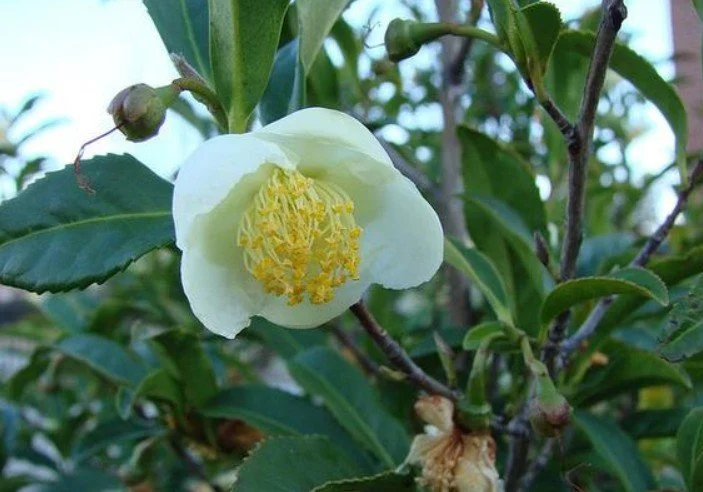
The Tea Camellia is a hardy evergreen shrub or small tree that is probably the most widely grown Camellia in the world traditionally used for caffeinated teas. They are harvested as the leaves emerge beginning early spring and processed in different ways to create white, green, oolong, and black teas. Smaller young leaves and leaf buds are used for making green tea, the older larger leaves for oolong and black tea, and the buds for white tea. There are two major varieties. Camellia sinensis var. sinensis is the Chinese variety that has small leaves and is more tolerant of cold weather hardy into USDA Zone 6. C. sinensis var. assamica is from the Assam region of northern India with larger leaves hardy to zone 7 and south. The differences in taste, color, and aroma between these teas are achieved by varying the variety, climate, harvest, oxidation, and processing.
This plant is slow-growing and easily maintained. Unlike many other Camellia species, it is heat and drought tolerant and can perform well in full sun. The attractive dense dark-green leaves and blooms make it a good plant for screening, foundation planting, hedge, or an attractive patio or container plant. For optimal tea production, it is best to prune to 4-5' just before spring growth to encourage shoots. The flowers attract bees and it is mildly resistant to damage by deer.
The Tea Camellia is a hardy evergreen shrub or small tree that is probably the most widely grown Camellia in the world traditionally used for caffeinated teas. They are harvested as the leaves emerge beginning early spring and processed in different ways to create white, green, oolong, and black teas. Smaller young leaves and leaf buds are used for making green tea, the older larger leaves for oolong and black tea, and the buds for white tea. There are two major varieties. Camellia sinensis var. sinensis is the Chinese variety that has small leaves and is more tolerant of cold weather hardy into USDA Zone 6. C. sinensis var. assamica is from the Assam region of northern India with larger leaves hardy to zone 7 and south. The differences in taste, color, and aroma between these teas are achieved by varying the variety, climate, harvest, oxidation, and processing.
This plant is slow-growing and easily maintained. Unlike many other Camellia species, it is heat and drought tolerant and can perform well in full sun. The attractive dense dark-green leaves and blooms make it a good plant for screening, foundation planting, hedge, or an attractive patio or container plant. For optimal tea production, it is best to prune to 4-5' just before spring growth to encourage shoots. The flowers attract bees and it is mildly resistant to damage by deer.